 | Nagara Senior High School Japan 502 - 0071 Gifu -shi Nagara Saigo-cho 1716 Tel + 058 231 1186 Fax + 058 231 1188 nagaraHS@zzz.or.jp jelede@yahoo.co.uk |  |
  |
 |
O-SHOGATSU    1st January  (New year)
The new year is one of the chief traditional
events of the year. We celebrate the new year.
We eat 'Osechi'. (prepared dishes).We must cook
Osechi before January 1st, so housewives can
relax and so they don't have to cook dinner.
Children receive 'Otoshidama' from grown-ups.
It's money. The older the children are, the more
money they can get. Children look forward to
'Otoshidama' every year.
	We visit a temple and we wish for happiness
for the new year. We display "Kagami-mochi".
Kagami-mochi is a ricecake. Mochi (rice cakes)are
made by pounding steamed rice. It is customary
to eat them on New Years Day. It is put into a
clear soup or in sweet bean soup , or broiled
and seasoned wirth soy sauce.
By Natsuki Yanagi |
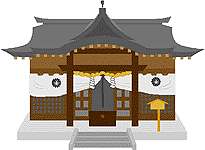 Shrine |
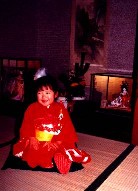 Young girl in kimono for New Year . |
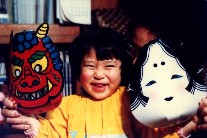 Setsubun festival Yukie with Oni mask . | SETSUBUN (3rd February)
Setsubun falls on the day before Risshun.
(Risshun is the first day of spring).
It is the 3rd or 4th of February. Now
its customs have been handed down in
several places. On this day we often
throw beans outside shouting : "Oni
wa soto-!, Fukuwa Uchi - !". (Devil
go outside, luck come inside) But
Fathers sometimes pretend to be Oni.
This photo is a memory of Setsubun
about 10 years ago. She is my sister.
At this time I was maybe only a few
years old. I don't remember it in
detail but only to find the photo was
fun. So I like this ceremony even now.
(ps...After we throw beans, we eat one
bean for every year of our age.)
by Yukie Tsuji |
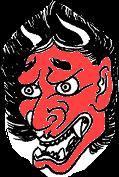 Japanese Devil 'Oni' |
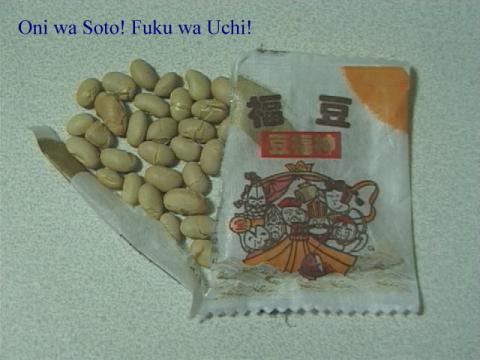 Oni beans thrown during Setsubun . |
ST. VALENTINE'S DAY  14th February
St. Valentine's Day is looked forward to more than any other day in the whole year. In fact St. Valentine
used to be an event in Europe. However it was brought to Japan and given meanings which are different to
its original one. It seems now as if it were originally an Japanese event.
	In Japan, St.Valentine's Day is said to be a day when women (only) confess their love to the men
closest to their hearts. Usually, women confess their love by giving chocolate and some presents. Some
women buy expensive stuff as presents, such as ties, wallets, sweaters and watches. Despite this, most
women make or buy alot of chocolate to give to the men around her.
	Because of the sense of duty and group harmony peculiar to Japan we also have 'Giri' and 'Ninjyou'
chocolate which is given to other male acquaintances , colleagues and members of family. Giri chocolate is
a way of keeping good relationships although it has no romantic meaning. On Valentine's Day, 60% of the
year's sales of chocolate are achieved.
	Most boys tend to compare and contend the number of chocolate they recieved with their friends.
If someone gets much more choclate than others, then he might start boasting about it contentedly. On the
other hand, others can't help envying him. And some mothers assess their son's popularity by the amount of
chocolate they were given.
	There is also a day however when men confess their love for the woman closest to their hearts and
also to thank women. This day is called "White Day". It's the 14th of March.

By Hitomi Maruyama |
HINAMATSURI    (March 3rd)
In Japan, the 3rd of March is a special day.
This day is called "Hinamatsuri". I like this
day very much . Because I can see Hina dolls
which are very beautiful and are on display
only once a year.
I like listening to the music of Hinamatsuri
too. The song is very famous.
	By the way, Hinamatsuri is a ceremony
for girls. This day means to wish for the
growth of girls. In fact , even now, I want
to be as beautiful as Ohinasama. (a Japanese
princess).So I always want to respect this
day.

by Yukie Tsuji |
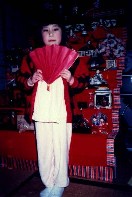 Yukie in front of Hina doll display . |
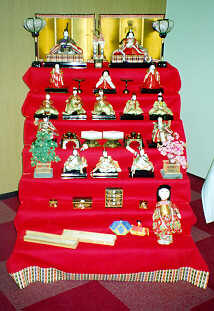 Hina dolls |
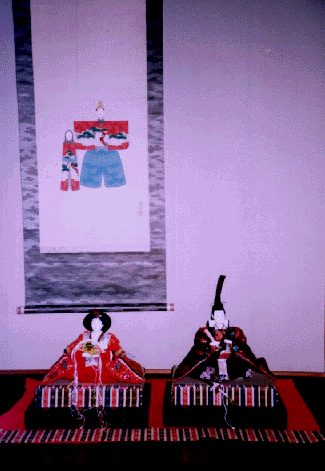 Hina dolls |
HANAMI (From end of March to beginning of April) Hanami means cherry blossom viewing in English. We go to see cherry blossoms every year. And many people enjoy just looking at them, but some people enjoy eating or talking or singing or drinking alcohol and so on under the trees. Do you know how long cherry blossoms last for ? To tell the truth - only 2 or 3 days. But it is very beautiful. Japanese feel the blossoms represent life. So you can hear then saying : "Great !" and "beautiful! ". | 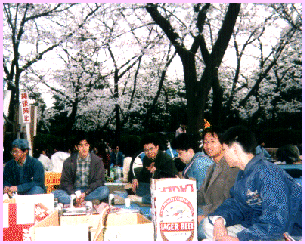 |  |
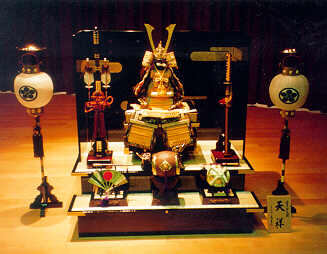 Musya doll ( warrior doll ) |
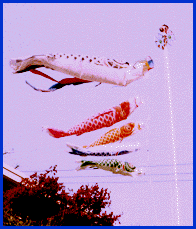 Carp streamers | CHILDREN'S DAY (May 5th) by Tomohiko Satoh. "Children's Day " is one of the famous festivals in Japan. It is held on May 5th. The May dolls are displayed in the homes of young boys to hope for health and growth. Carp (fish)- shaped streamers are also displayed outside the house. On this day we eat 'Chimaki' and 'Kashiwamochi'. Chimaki are pounded rice cakes and kashiwamochi are also pounded rice cakes filled with sweet red beans and wrapped in the leaf of a Kashi tree. These are delicious. I like them very much, so I like this day. |
TANABATA (7th JULY ) by Tomohiko Satoh. 'Tanabata' is one of the most famous festivals in Japan. It is held on July 7th. We write wishes on oblong bits of card and tie them with string onto bamboo grass. Then we display them in the garden or balcony on this day. I used to write my wishes with my friends. So this event was a great treat for me. |
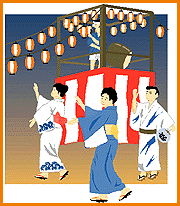 Dancing at Obon |
OBON        (August 13th - 15th)
The Obon festival is one of the chief traditional
events of the year. Our ancestor's spirits return
back to the home in August from the 13th - 15th.
We return to our home towns to entertain our
ancestor's spirits every year. There we chant a
sutra for our ancestor's spirits. And August 15th
the spirits of our ancestors go back to the next
world.
	We have the Obon dance. We wear Yukata.
Yukata is a type of summer kimono. Yukata is more
refreshing than Kimono. And we go to the temple
or the park where we all dance.
By Natsuki Yanagi |
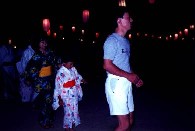 Obon dancing 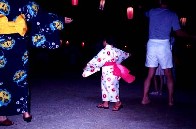 |
HEALTH / SPORTS DAY   10th October
We exercise on this day. From children
to grown-ups and even old men do sports.
In fall season we do many things, sport,
eat good food, read books and study. Sport
especially is exciting in Fall. We have
lunch with people we don't know and this
day's lunch tastes especially good. After
doing sport we feel happy and everyone
thinks it's pleasant.
NICE DAY !!!
By Sachiko Hosono | 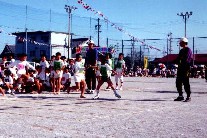 | SHICHI-GO-SAN Day (7-5-3 Day)23rd November
In Japan , odd numbers are very lucky.
So when we are 3 or 5 or 7 years old,
we go to the temple on this day to wish
for our growth. And we suck candy called
Chitose-ame. Chitose-ame means long-life
candy.
by Ryosuke Naitoh |
OHMISOKA 31st December by Ryosuke Naitoh We call the last day of the year Ohmisoka. On Ohmisoka, we clean our room, eat Toshikoshi-soba and listen to Toyanokane. We clean our room to wait for the new year in our best condition. Toshikoshi-soba means : long- life noodles. We eat them for good health in the next year. The Kane part of Toyanokanemeans bell. We listen to the bell 108 times after the stroke of 0:00am |
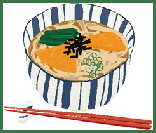 Toshikoshi-soba |
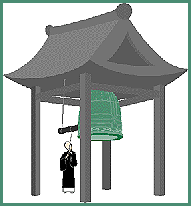 Joyanokane bell |
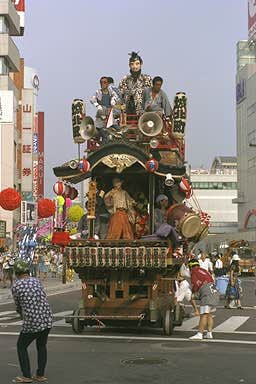 Japanese Omikoshi (portableshrine) |  |
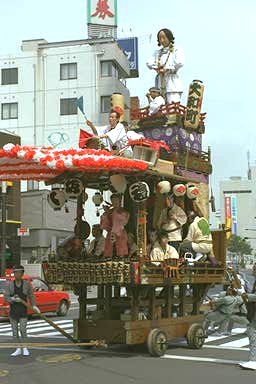 Omikoshi are brought out during festival . |