Newsletter around the world: December, Goethegymnasium Hildesheim, Germany
Hello to all of you and a happy New Year 2001
You may
have heard about German festivals and feast from the other German participants
in this programme, nevertheless there are some regional differences which may
make it worthwhile to send another letter on this from Germany.
Germany is
said to be a Christian country with a long Christian tradition and as such a
part of Europe. So we celebrate Christmas, Easter, Whitsuntide,Corpus Christi
Day, All Saints, Ascension, Thanksgiving (although with much less importance
than e.g. in the US) like all the
others.
There are
more Roman Catholic holidays than Lutheran ones. They are celebrated only in
those federal states of Germany (Bundesländer) where the majority of Christians
is Roman Catholic (, which is so in the Bundesländer along the Rhine River and
in the South).
Reformation
Day,31th October, is what is held high by the Lutherans. On this day Martin
Luther’s coming out with his 94 theses how to reform the church in 1517 is
commemorated.
A secular
national holiday is 3rd Oct. This was when eleven years ago, East
Germany (the then Communist GDR) and West Germany were reunited after 40 years
of separation, not only of the country, but also of families, children not
being able to see their parents, brothers and sisters not being able to visit
each other (at least not without great difficulty).
Another
national holiday is “Volkstrauertag” (Day of National Mourning) on 19th
November. Then Germans commemorate the people who died in the two world wars,
our own soldiers and civilians as well as the appalling number of the other
people all over the world having been killed in the wars. Germany of course has
nothing to be proud of as to these happenings, because our country played,
alas, a sad part in these wars, as you know.
The
Fasching-season (Carnival) is something very German probably. It starts on 11th
Nov. at 11.11 when carnival clubs all over the country start to prepare for the
high sesaon of Carnival in mid-February, which is Monday before Lent to Ash
Wednesday. Formerly this had a profoundly religious background, today it is
three days of collective merrymaking mainly in Western and Southern Germany.
People there don’t go to work, there are mass pageants, almost everyone
disguises himself dressing in costumes, eat and drinks a lot (too much, as the
more sober-minded Northern Germans, to whom we belong, often think) and even
some of the stricter codes of conduct between the sexes seem to lifted in that
time(!). Generally speaking people enjoy slipping behind the mask of the joker,
who can do and say things unpunished, which people in their ordinary, serious,
sober, day-light identities must not do or say.
1sst April
is All Fools’ Day in Germany, too. All sorts of jokes may be played on you.
Especially teachers are very much aware of tricks played on them by dexterious
students.
How about feasts
then: 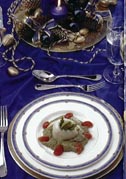
Having
studied the many beautiful newsletters on the theme, we have realized that we
live, indeed, in one world. Only maybe our delicatessen vary slightly because
we live in another region than you do.
In the time of Advent we prepare for
Christmas. In the culinary respect this means that many families do a lot of
baking, “Printen”, “Lebkuchen” (both a sort of ginger bread), “Kipferl” and
“Weihnachtskekse” (both summary terms for Christmas cookies,- there are
probably hundereds of different sorts, depending which region of Germany,
Austria or Switzerland you have your recipe from, -and it’s really the
families, not just the housewives doing the baking, because it’s great fun for
the little kids to help putting on all sorts of icings, having various
colorings,- don’t ask what a kitchen looks like afterwards!).
Things are
a little different with the muslims in our form. They do quite some fasting
during the day, but they have a splendid meal after sundown, cooking things
with lamb, tomato and lentils in it.
On
Christmas Day we have turkey, a goose or some other roast. (Our big day for the
kids is Christmas Eve though, - gifts etc.) On New Years Eve, that is eight
hours form now actually, we have another nice dinner as part of a fete.
In our
region of Lower Saxony in Northern Germany we eat a rather dodgy meal called
“Gruenkohl und Bregenwurst” (green cabbage and a sausage stuffed with brain,
fat, meat and spices, - all cooked). This year, however, we probably won’t have
it because of the widespread worries of German consumers in view of the mad cow
disease here.
Let us
close for this year sending you our best wishes and hoping for more good things
out of this exchange of letters.
Form 9a of Goethegymnasium
Hildesheim, Bernd Hildebrandt (form teacher)
If you want to listen to Sarah
singing you a song - not for Christmas, she
thought those weren’t good enough for this occasion - then click on the below Advent picture.
It takes you to the virtual schoolpaper. Click the green show-me button there
next to the upper-most picture:
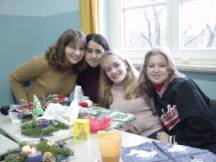 (from left to right: Sahrah, Lili, Sina and
Lisa having
(from left to right: Sahrah, Lili, Sina and
Lisa having
Advent Coffee in our classroom)